

Ideas and do they matter?
As a career creative, my answer is a resounding ‘yes!’…and this is why.
Contemporary chatter around the value of AI in creativity and creative execution continues, but while we criticise and critique the resulting work, we’re not seeing what’s missing. An idea.
It’s the reason. The connective tissue between a situation or need, and what you’re offering.
Shiny and new
There is immense value in embracing what’s new, it opens our minds to fresh possibilities. However as useful and exciting tools such as AI are for efficiency and polish, I believe them fundamentally flawed for ideation. For me, and many other creative operators, ideation requires a notebook and a pen, and space for your mind to create. Leaping on screen to push and prompt and experiment and explore is great, but it won’t magic up an insight and unless done extremely well, won’t generate emotion. You might watch the ‘story’ unfold and feel something…right up until that third arm or ‘jump cut’ style hand movement catches your eye. Or perhaps it’s just a bit off and your mind stalls, trying to work out what’s irksome…and the spell is broken.
A weak idea can’t be saved by slathering it in high quality craft. It may entertain in the moment but it quickly fades. Real connection, meaning and emotion is memorable.
Creativity, is not an ‘on demand’ service.
That might sound odd in the context of advertising, marketing and writing projects that must adhere to a commercial deadline, but somewhere along the way we forgot what boredom feels like. Constant engagement and dwindling attentions have removed the freedom of allowing our minds to truly wander. We no longer stare into space, any moment of waiting triggers the instinctual response to pull out our phone and we’ve lost something by doing this.
This freedom to scribble, write random words as we create stories in our minds as we test the elasticity of the brief is one of the joys of creativity. How what we know and what insight we’re told meld together floating down through our consciousness to spur ideas is where the magic happens. And sometimes that magic appears on a scrappy envelope in the back of a NYC cab.
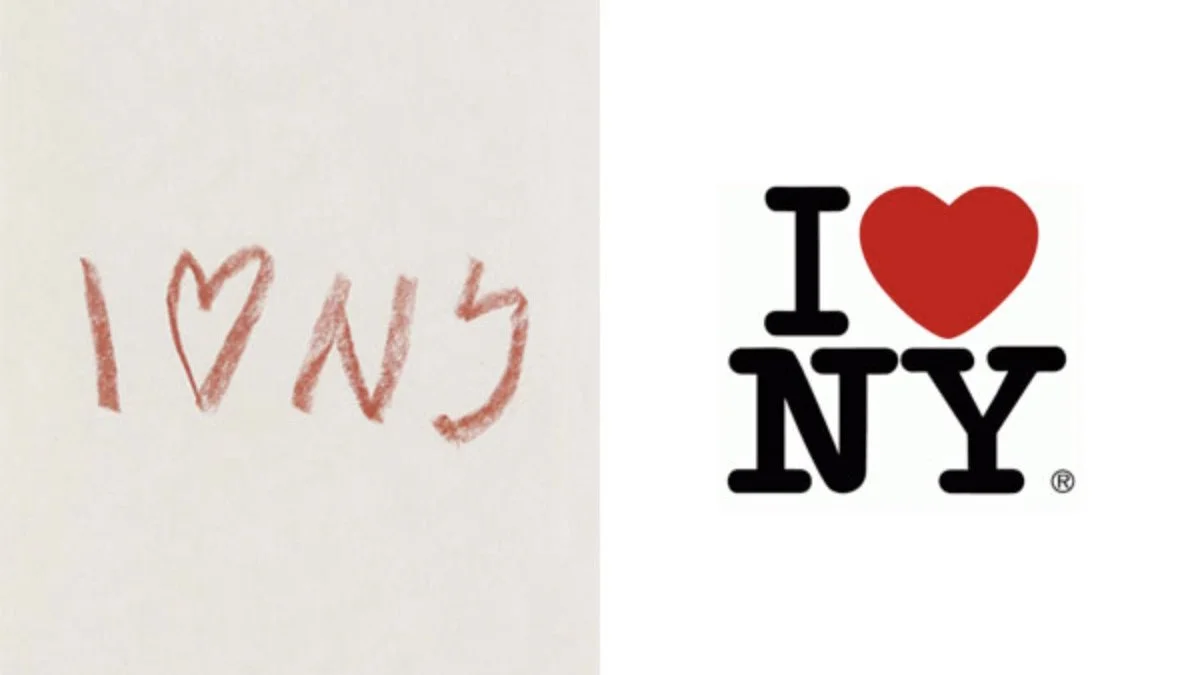
Designer: Milton Glaser 1976
This design has become one of the world’s most recognisable, and was the result of a campaign to boost the city’s reputation. NY was struggling with rising crime, worker strikes and imminent bankruptcy, yet there was still positive sentiment for the city. Milton Glaser, a graphic designer responded with a design that has become one of the world’s most recognisable, and in Glaser’s words:
“The original imagery derived from my memories of carvings in tree trunks where the initials of lovers were combined with a heart.”
I’ve always maintained that I can’t think without a pen in my hand…and there is science that supports it.
“Handwriting is a complex neurophysiological process integrating motor, cognitive, and emotional components. [It] activates a broader network of brain regions involved in motor, sensory, and cognitive processing. Typing engages fewer neural circuits, resulting in more passive cognitive engagement.”
- National Centre for Biotechnology information
If you allow expression to drive the creative strategy it will prove that it has no direction. This is rife in the glut of ‘AI slop’ and the ‘efficiency vs effectiveness’ debate has entered the lexicon. But, most distressing of all is the growing ‘creative atrophy’ - the point at which your human input or discernment is surrendered, you no longer trust your ability to wrangle a problem or value the time it takes to nut it out.
Initiating a creative journey from a prompt and not the creative mind is a glaring red flag:
Firstly, the high resolution creates the perception that what you have is polished and fully crafted. Although impressive, unless your brief is an advertisement for the AI tool itself, showcasing its capabilities does little for your own product. And in fact, the lack of substance clouds the message. Things present as finished before any interrogation of whether it even serves the objective.
And secondly, while some of the AI work flying around the socials is mind-blowingly good. Hyper-real and with a detail-rich intensity that is truly stunning, apart from a moment of wondrous escapism, what is the audience actually left with?
In Summary
An idea is not a tagline or a graphic treatment. Nor is it regularly found in the onslaught of AI explorations that have plagued our social media platforms. But rather it’s a sinuous thread. One that needs to be woven into a convincing reason that transports a discerning audience and persuades them to purchase.
Written by Tania De Masi